One trail at a time
When Dave Kull stumbled across a list of the best hikes in every state, he did what he usually does — started making plans. His wife, Jill, heard the idea and braced herself.
“His idea of traveling is to be on the go and travel all around,” Jill said. “I like to go somewhere and settle.”
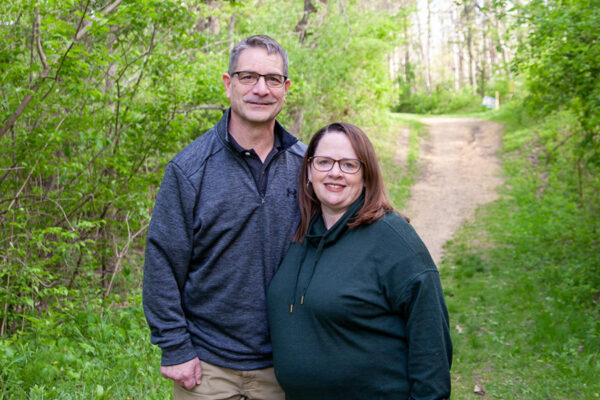
Since August 2017, the Eldridge couple has set out to hike in all 50 states. Nine years and 45 states later, the two have just five left. They plan to finish the job. They just don’t know when quite yet.
 Starting in the weeds…literally
The first hike, chosen with the same enthusiasm that would carry them across the country, was the Loess Hills in western Iowa. Dave had researched the options. He picked what sounded like a legitimate trail.
It was not.
“It was totally unmaintained. You could hardly tell there was a trail. By the time we were heading back, the weeds had swallowed whatever path had existed,” Dave said. “Jill is 5’ tall on a good day. The weeds were as high as her shoulders. We made our own trail, but that ended up being one of the easier hikes we’ve been on.”
They were hooked.
Dave, now an engineer at Watersmith Engineering in Muscatine, grew up with a father who loaded the family into a converted van every summer and drove somewhere new. They made it to Alaska three times, the first in 1978 when the Alaska Highway was still 2,000 miles of gravel. Adventure was simply the family language.
Jill grew up outside Cedar Rapids, Iowa. Her big trip as a kid was loading up the pickup truck to go to St. Louis with some Adventureland trips sprinkled in.
“You’ve come a long way with your travels,” Dave likes to remind her.
The method
Their system is straightforward. They use the AllTrails hiking app to research hikes, filtering by difficulty and reading reviews from other hikers. They try to choose something representative of each state — a swamp in Louisiana, a mountain trail in Colorado, plains in Iowa. They drive to all of them, often moving through one or two states in a day, staying overnight and starting fresh the next morning somewhere new.
A pipestone turtle is their constant companion in the car. They bought it at Pipestone National Monument in southwest Minnesota on one of their early trips, where Native Americans have long mined the soft red stone and carved it into figures and ceremonial pipes. It goes everywhere with them now.
The planning stays loose by design. Dave is known to spot a roadside sign mid-trip and redirect entirely. On one East Coast drive, a sign pointing toward Assateague Island changed the day’s itinerary. The unplanned change allowed the couple to experience the beauty of the wild horses that roam the barrier island’s sand dunes along the Virginia and Maryland coast.
Where the trail gets hard
Not every stretch of this journey has been about scenery.
A few years in, Jill started having trouble with her vision and balance. On a hike in North Dakota’s Theodore Roosevelt National Park, she couldn’t see clearly and had to grip Dave’s jacket and watch his feet to make it back down the trail. A lengthy diagnostic process eventually brought an answer: multiple sclerosis.
“We almost gave up,” Dave said. “But we’re going as long as we can. As many states as we can.”
Dave has cerebral palsy, a condition that didn’t significantly limit him earlier in life but has become more present with age. He had surgery on his left foot last fall and is still recovering, working through strength training to get back on the trail. The couple hasn’t hiked since.
“Before, Jill was having a hard time keeping up with me,” Dave said. “Now I’m the one lagging behind.”
They go slow. They stop when they need to. They keep going.
Jill is also in the middle of a master’s program in library science through Louisiana State University — a non-traditional student making time for coursework. Dave joined Watersmith Engineering last year after years in water and wastewater engineering, including a stint as state engineer for USDA Rural Development, where he helped small Iowa communities finance water and sewer projects.
The places that stick
Ask Dave for a favorite and he’ll tell you about Kasha-Katuwe Tent Rocks National Monument in New Mexico. The park sits in high desert and is easy to miss from the road. The trail moves through slot canyons before climbing toward views that stretch for miles, passing tall volcanic rock spires worn into cone shapes by erosion. At one point in their trek, large boulders blocked the path entirely. A stranger helped hoist them over.
“You meet the nicest people on the trail,” Jill said. “Everyone is so helpful and friendly.”
Jill’s list includes a hike through Pennsylvania’s shaded forest trails and an early trip through Florida. She has developed a habit on the trail: photographing wildflowers. It gives her something to focus on, a reason to slow down and look closely at what’s underfoot.
She is also honest about the parts she doesn’t love.
“I’m not a fan of the heat or the bugs,” she said, noting that the bugs seem to prefer her.
Dave has learned to walk close by. The insects find her first.
“At least one of the hikes on each trip, there will be a meltdown,” Dave said, with some affection.
“We go slow and steady. He puts up with my meltdowns and I put up with his crazy ideas,” Jill laughed.
The last five
Washington. Idaho. Oregon. Montana. Wyoming. The Northwest is waiting.
Dave is in physical therapy. Jill’s coursework continues. They left for a different kind of trip in mid-May to celebrate their granddaughter’s first birthday. The two enjoy spending time with their three boys and grandkids. Murphy, their 5-year-old mini Australian shepherd, has made a few hikes of his own — Louisiana, Mississippi, Missouri — though he tends to reach his limit before the trailhead.
The plan for when they finish all 50 has always evolved. Hawaii was supposed to be the final state, the grand finale. Then Dave’s sister organized a trip there last year and they went. So that plan changed.
What hasn’t changed is the reason they started, getting to experience each state’s many wonders together.
“Every state has these hidden treasures that no one would know were there unless you happen upon them. When you do stop, it’s amazing,” Dave said. “All of God’s beautiful creation. You look around and think — what were you thinking when you made this?”
Forty-five states in. Five to go.